

A Property Owner’s Guide to Site Demolition
October 9, 2026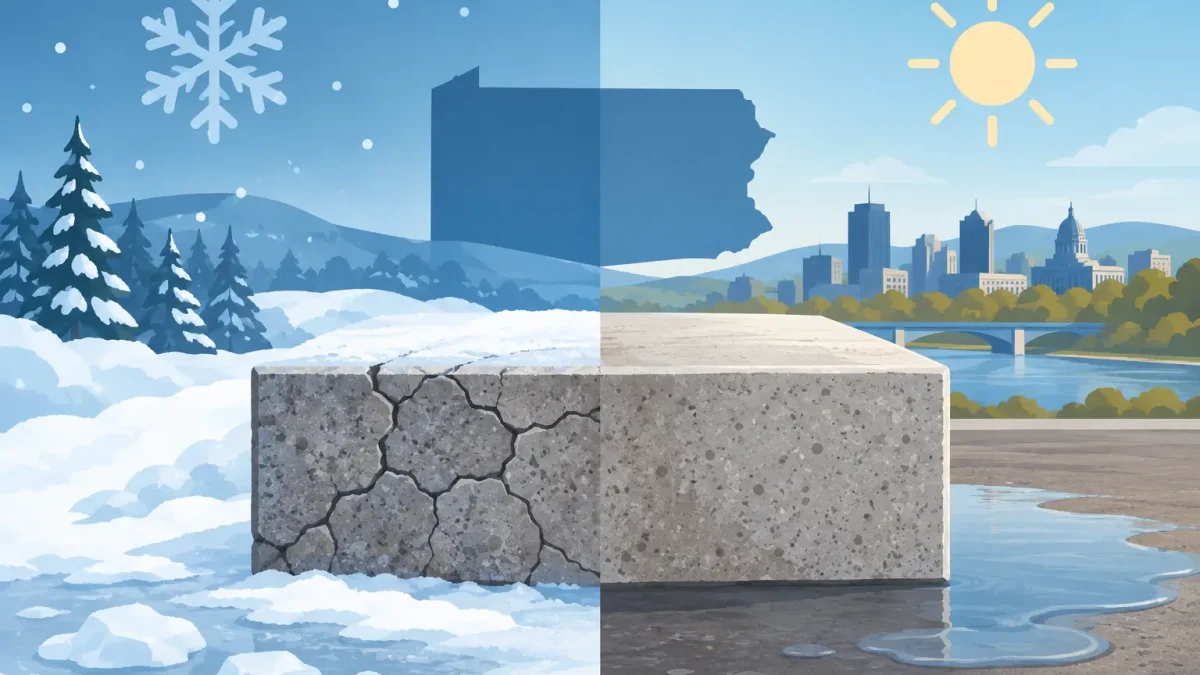
A Pennsylvania winter can turn a small concrete defect into a major repair. Water enters an open joint, shallow crack, or porous surface during a thaw. Then temperatures drop overnight, that trapped water expands, and the slab begins to chip, scale, or crack. So, can concrete withstand freeze thaw conditions? Yes, but only when the concrete is designed, installed, and maintained for the climate.
For driveways, sidewalks, patios, steps, and commercial walkways across the Main Line, freeze-thaw durability is not an optional upgrade. It is a basic requirement for a surface expected to remain safe, attractive, and functional through repeated winter weather.
Can Concrete Withstand Freeze Thaw Cycles?
Concrete can withstand freeze-thaw cycles because properly made concrete contains a controlled system of tiny air pockets. This is called air entrainment. When moisture in the concrete freezes and expands, those microscopic voids give the water somewhere to move instead of forcing the surface apart.
That distinction matters. Concrete is strong in compression, but it is not waterproof and it is not immune to movement. A dense, well-proportioned concrete mix with entrained air, proper thickness, sound base preparation, and adequate curing will perform far better than a slab placed quickly on poor soil or finished with excess water.
The challenge in Pennsylvania is repetition. A single freeze may not cause visible trouble. Dozens of freeze-thaw events over a winter can steadily widen cracks, loosen the surface paste, and expose aggregate. The damage is often most noticeable in spring, after moisture has had months to work into vulnerable areas.
What Freeze-Thaw Damage Looks Like
Freeze-thaw damage does not always begin with a dramatic crack. Homeowners and property managers often first notice flaking along the top layer of a driveway, rough patches on a sidewalk, or small pits where the surface has broken away. This surface loss is commonly called scaling or spalling.
Cracks can also worsen when water reaches the slab base or gets beneath edges. As frozen ground and trapped water shift, sections of concrete may settle unevenly or lift slightly. On a walkway, even a modest height difference can become a trip hazard. On a driveway, it can create low areas that collect more water and accelerate the cycle.
Not every crack is caused by freezing. Concrete naturally shrinks as it cures, and soil settlement, tree roots, heavy vehicles, and poor drainage can all create cracks. Freeze-thaw weather usually acts as an amplifier. It turns an existing opening into a route for water, then uses expanding ice to make that opening larger.
The Installation Details That Make the Difference
A durable exterior slab starts below the concrete. The subgrade must be stable, graded correctly, and compacted to support the intended load. A residential patio and a driveway do not carry the same demands, and a commercial loading or access area requires a different level of preparation again.
The concrete mix must also suit exterior exposure. Air-entrained concrete is standard practice for surfaces exposed to freezing weather, especially when they will receive rain, snow, and deicing products. Lower water content generally produces denser, stronger concrete, but the mix still needs enough workability for proper placement and finishing. Adding water at the jobsite to make concrete easier to spread can weaken the finished surface if it is not carefully controlled.
Thickness is equally important. A patio may perform well at a different thickness than a driveway that supports passenger vehicles, delivery traffic, or heavier equipment. Reinforcement can help manage cracking and keep sections aligned, but it does not replace proper slab thickness, a compacted base, or control joints.
Control joints are planned grooves that encourage concrete to crack in a controlled location as it shrinks. They do not prevent all cracking. They help create clean, predictable crack lines rather than random breaks across the surface. Joint placement, depth, and spacing should be planned before the pour, not treated as an afterthought.
Curing is another step that affects winter performance. New concrete needs time to gain strength and retain moisture during the early curing period. Finishing and curing shortcuts can leave a weak surface layer that scales more easily once winter arrives. For exterior work, timing matters as much as technique. Concrete should not be placed when temperatures, rain, or an imminent hard freeze prevent proper installation and curing.
Drainage Protects Concrete From Winter Damage
Water is the active ingredient in freeze-thaw damage. Managing it is one of the most effective ways to protect concrete.
A patio should slope away from the home. A driveway should direct runoff toward a suitable drainage path rather than hold water at the garage, along an edge, or over low spots in the slab. Downspouts should not discharge directly onto concrete where water can pond, flow beneath the slab, or repeatedly soak a joint.
Good drainage also protects the base. When water saturates soil beneath a slab, freezing conditions can cause movement and loss of support. The concrete above may remain structurally sound, yet crack because the foundation beneath it is unstable. This is why a surface-level patch is not always the right repair for recurring cracks or settled sections.
On commercial properties, drainage deserves particular attention near entrances, sidewalks, dumpster pads, parking areas, and loading routes. Standing water becomes both a durability issue and a winter slip hazard. A properly graded concrete replacement can improve safety while reducing the conditions that lead to premature deterioration.
Deicers Can Make Surface Damage Worse
Deicing products are often necessary for safe access, but they should be selected carefully. The main concern is not simply melting ice. Some products can increase freeze-thaw stress by pulling moisture into the concrete or creating more frequent wet-and-freeze cycles.
Avoid using rock salt on new concrete during its first winter whenever possible. Sodium chloride can contribute to scaling, especially on young or already vulnerable surfaces. Products containing calcium chloride or magnesium chloride can also be hard on concrete under certain conditions. Fertilizer-based products should never be used as deicers because they can chemically damage concrete.
For ordinary snow and ice removal, shovel promptly and use sand or other traction material when practical. If a deicer is needed, follow the manufacturer guidance for use on concrete and apply only what is necessary. More product does not mean better protection for the slab.
Metal snowplow blades and sharp shovels can also damage high spots, exposed edges, and decorative finishes. Property managers should make sure snow-removal crews understand where control joints, steps, curbs, and finished concrete transitions are located.
Sealing Helps, But It Is Not a Cure-All
A quality penetrating sealer can reduce water absorption and improve resistance to freeze-thaw damage. It is especially useful for older concrete that remains structurally sound but has become more porous over time. The right sealer allows moisture vapor to escape while limiting the amount of liquid water that enters the surface.
Sealing cannot repair a failing slab. It will not correct poor drainage, major settlement, deep structural cracks, or widespread spalling. Applying sealer over loose, deteriorated concrete may temporarily change its appearance, but it does not restore the material below.
Before sealing, concrete should be clean, dry, and free from failed coatings or contaminants. The product must match the surface and its intended use. Decorative concrete, broom-finished driveways, natural stone, and masonry each have different requirements. A professional evaluation can prevent the common mistake of using a coating that traps moisture or creates an unwanted slippery finish.
Repair or Replace? Make the Decision Early
Small, stable cracks can sometimes be cleaned and sealed to limit water intrusion. Isolated surface defects may be repairable if the slab is otherwise level, well supported, and free from widespread deterioration. The key is addressing the cause, not just filling the visible opening.
Replacement is often the better long-term value when a concrete surface has extensive scaling, multiple settling sections, recurring water problems, or cracks that continue to move. Replacing only the damaged area without correcting base preparation or drainage can lead to the same failure pattern in a few seasons.
An experienced contractor should assess the slab thickness, subbase condition, joint layout, drainage, and surrounding structures before recommending a solution. Clear scope and pricing matter here. At Provato Concrete, Demolition & Masonry, the goal is to identify work that solves the actual problem and to proceed without unapproved upcharges.
Protecting Concrete Through a Pennsylvania Winter
The most practical maintenance is also the least complicated: keep drains and joints clear, remove snow before meltwater refreezes, avoid unnecessary deicer use, and watch for new cracks or low spots after winter storms. Early attention can keep a manageable issue from becoming a full replacement project.
Concrete can handle Pennsylvania’s freeze-thaw weather when the details are right. If water is draining properly, the slab was built for exterior exposure, and early damage is addressed before another winter, your driveway, patio, or sidewalk has a far better chance of delivering years of dependable service.